
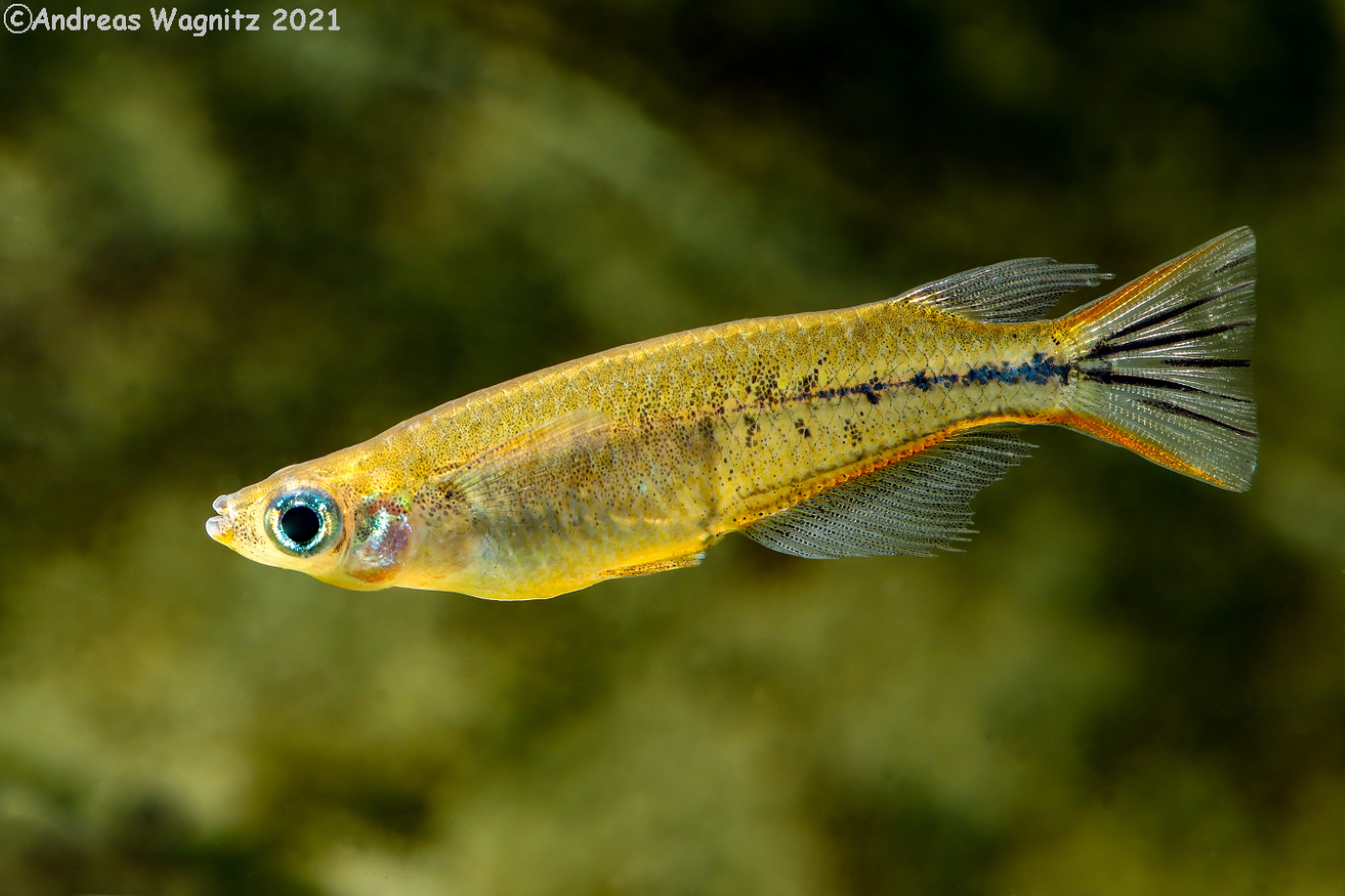
The story of how I came to own Oryzias celebensis is rather curious. I was originally supposed to receive the species in 2022, but the packages were mixed up, so the O. celebensis intended for me ended up in Turkey, and I received a different rainbowfish species instead, one that was actually meant for our Turkish friend. I didn't encounter O. celebensis again until 2025, and in a rather exciting and unusual way!
In a very good aquarium shop, whose owner often reserves special items for me, there were some truly fantastic specimens of Marosatherina ladigesi. So, I took the whole group home and noticed that among the Marosatherina was a single ricefish, which I could easily identify as O. celebensis. This could only be explained if they were wild-caught, which was confirmed after some research. Both species occur partly syntopically in the highlands of Maros. So, unexpectedly, I had not only wild-caught M. ladigesi but also a wild-caught female O. celebensis swimming at home.
Unfortunately, the search for suitable males was initially unsuccessful. However, I was determined to seize the unexpected opportunity to breed this wild-caught specimen. Finally, I was able to acquire a dozen captive-bred O. celebensis from another dealer, from which I selected four particularly beautiful and robust males to breed with my female.
Oryzias celebensis is not particularly demanding. The water should, of course, be free of nitrogen compounds, and the species should not be kept at excessively high temperatures for extended periods. As previously mentioned, this species originates from the somewhat higher elevations around Maros and inhabits suitable waters there. While the species can also be found in more central parts of Sulawesi, it does not tolerate consistently high temperatures. Similarly, the water should not be too soft or acidic, as the region around Maros is characterized by karst landscapes. Feeding is completely straightforward; any appropriately sized food is readily accepted.
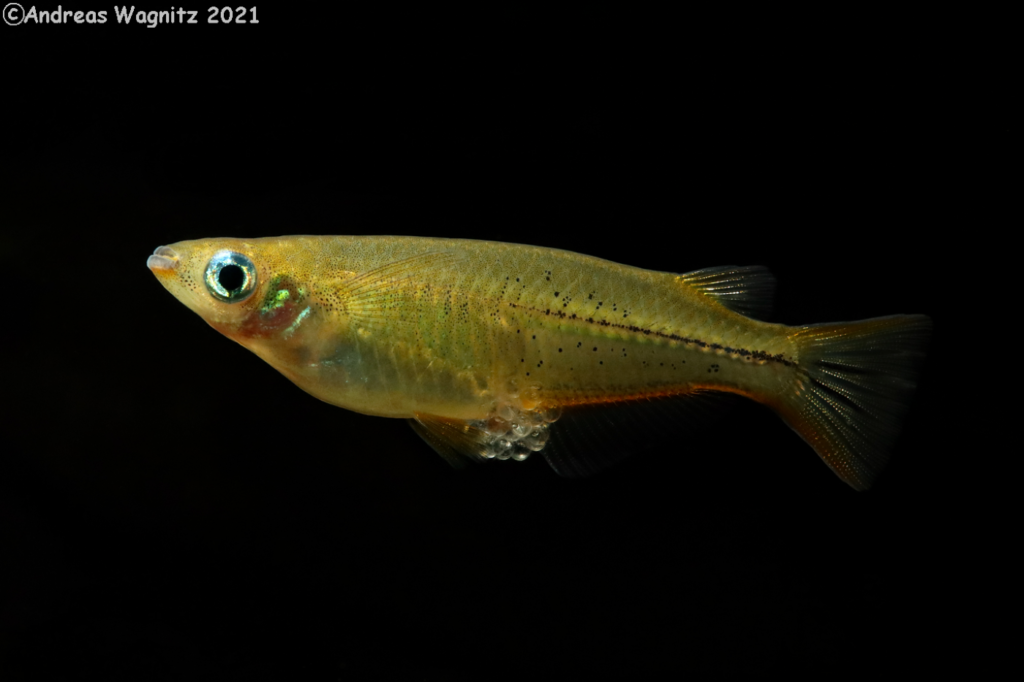
O. celebensis isn't exactly one of the larger ricefish species, but it's definitely one of the least shy. Whether kept in a species-only aquarium or with other suitable fish, such as M. ladigesi, they are very lively and delight the observer with their bluish stripe. Another pleasing characteristic is their apparently quite uncomplicated breeding. There are a few older populations of this species in the aquarium hobby; I personally have no experience with these. In particular, I can't comment on possible differences in keeping, breeding, or behavior of these longer-established strains compared to my "half-wild-caught strain”. I deliberately chose to breed exclusively with this single wild-caught female and paired her with several males to obtain as many "half F1" offspring as possible in the first generation.
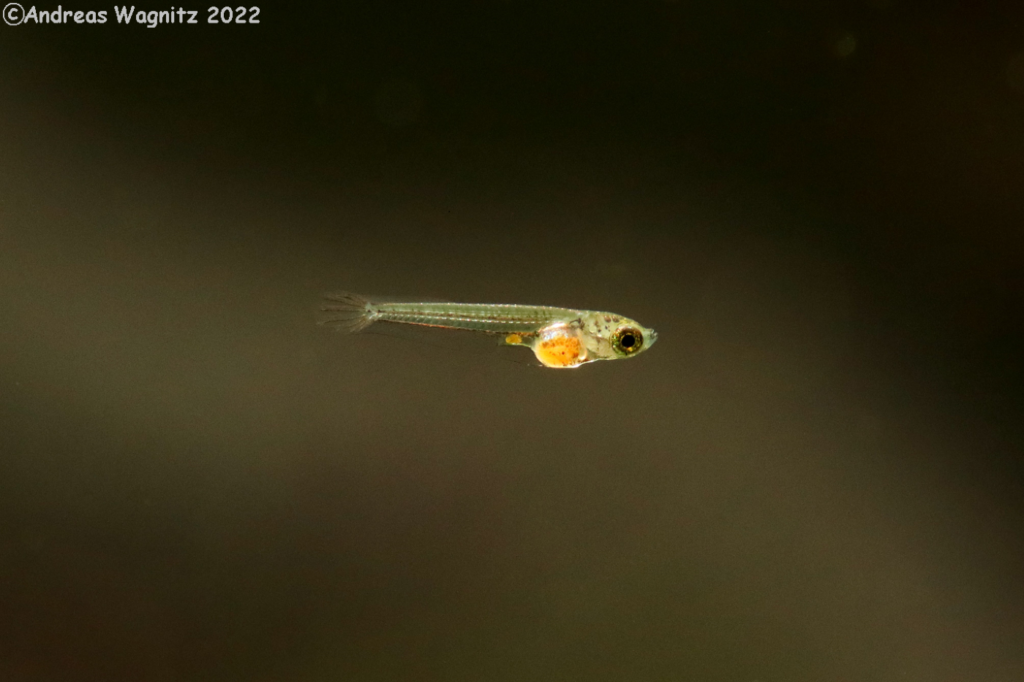
The pairings described went very smoothly. I placed the female with a male in a 20-liter aquarium, which was furnished exclusively with sand as substrate and a spawning mop. After approximately three weeks each time, I replaced the male and the spawning mop to ensure that I had indeed obtained offspring from each of the selected males. As I said, this worked very well; I obtained between 20 and 25 fry from each attempt.
Raising the fry was, as expected, very easy. For the first few days, they received the finest dry food, and then increasing proportion of freshly hatched brine shrimp nauplii.
This story shows that sometimes, with luck and a good connection to a dedicated dealer, you can experience wonderful surprises!
Gunnar Loibl
